
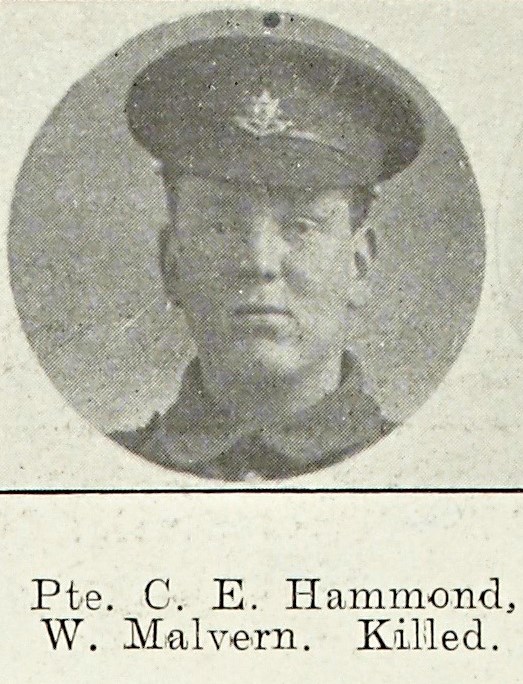
Charles Hammond was the son of Thomas Hammond, a plasterer and Hannah his wife of Rye Croft, Lower Road, West Malvern. He attended Malvern Link Council School, like his older brother, probably followed his father into the plastering trade.
First World War
On 21st September 1914, he joined the “Malvern Chums”, a company strength group of territorial recruits that became part of ‘C’ Company the 8th (Reserve) Battalion (later 2/8th) Worcestershire Regiment. They trained in Malvern, before being billeted in Worcester. While in Worcester, Charles was was billeted in Vincent Road and known, perhaps ironically, as “Tiny”.
The battalion, part of the 2nd South Midland Division, later took over coastal defences in Essex from the 1st South Midland Division, which deployed to France in April 1915.
In September 1915, the battalion were at Wintry Park Camp near Epping. The camp was visited by local photographer C J Wilkinson from Huxley Road, Leyton. He took this picture of C Company, and Charles Hammond is sat on the far left.
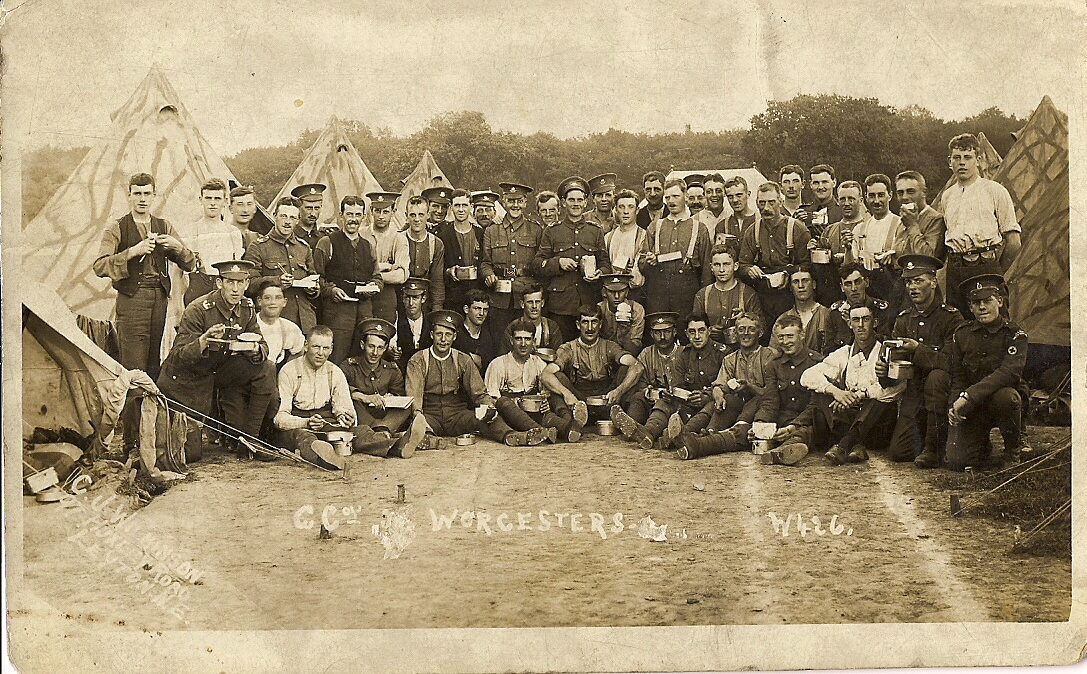
Men of C Company 2/8th Worcestershire at Epping, enjoying tea and tinned pineapples. September 1915.
He wrote on the reverse to his parents:
Dear Mother and Father. Just a card of the tribe at tea. It was took last Friday week. We were feasting on bread and butter and pineapple. Maybe you recognise me in the front rank. I remain your loving son, Charles E Hammond.
Deployment overseas
The 2/8th Worcestershire Regiment landed in France in May 1916 and after initial training and familiarisation, occupied trenches in the Laventie/Fleurbaix sector. Pte Hammond was well known in his platoon and took part in early trench raids .
On 2nd October the 2/8th Battalion took over trenches from their sister battalion the 2/7th Worcestershire. They held the right sub-sector of the Neuve Chapelle trenches as before. Sadly not long after taking over the line 2889 Pte Charles Hammond was killed in action by a German trench mortar round.
His parents heard the tragic news from their son’s platoon commander:
Your son was the best man I had in my raiding party always willing, hardworking and loved by all. His loss is a battalion loss. Everyone misses his cheery face – I especially as I was his platoon officer. With deepest sympathy from all the boys of the platoon.”
A fellow Malvern “Chum” wrote:
“Charlie was liked by all, not only in the company, but by everyone in the battalion and was very much respected by the platoon officer. His death was instantaneous.”
Burial
Charles Hammond was laid to rest near the battle line at Pont-du-Hem Military Cemetery, La Gorgue. This cemetery was begun, perhaps fittingly for a son of Worcestershire, in an apple orchard in July 1915 and used until April, 1918, by fighting units and Field Ambulances. The village fell into German hands between April and September 1918 and German forces used the cemetery.
After the Armistice, 426 German graves were removed to other cemeteries; 1 Portuguese graves of 1917-1918 were removed to the Portuguese cemetery of Richebourg-L’Avoue; and British graves were brought in from smaller burial grounds and from the surrounding battlefields.
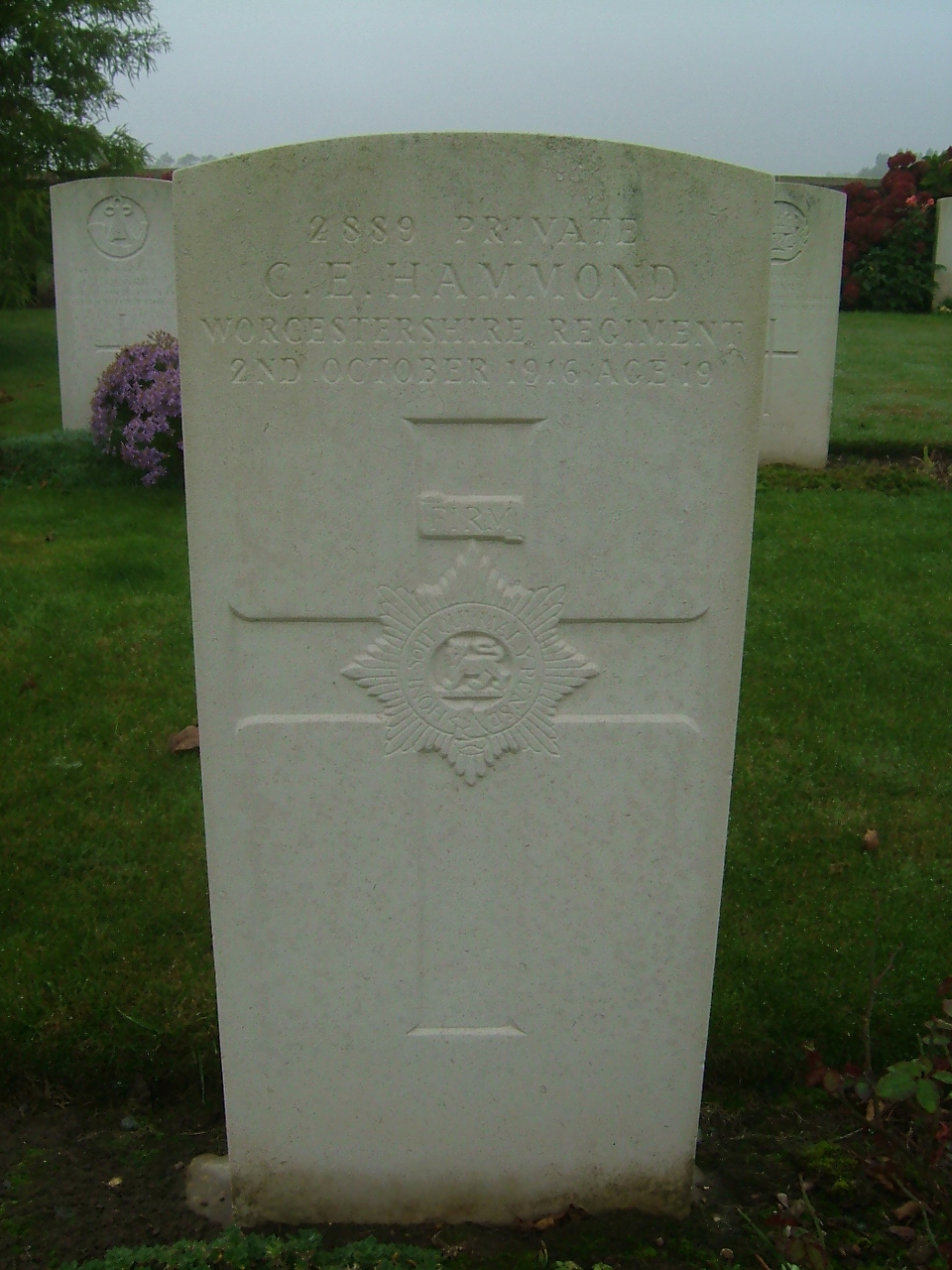
Charles Edward Hammond’s grave at Pont-du-Hem Cemetery, La Gorgue, France
Malvern News 14/10/16
Stevens Annual for 1914 Malvern 1914

